Specification and source review ·
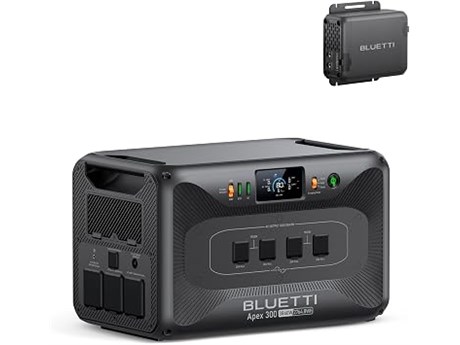
BLUETTI Apex 300 + Charger 1: Specs & RV Power
PortablePowerDB buying analysis
A stronger inverter does not mean a larger energy reserve
Apex 300's 3840W continuous AC ceiling exceeds Elite 400's 2600W, but its 2764.8Wh battery is smaller than Elite 400's 3840Wh. That is a meaningful tradeoff: choose Apex when the actual steady load requires the higher ceiling, and compare the energy cost of keeping that load running.
- Choose it when
- The verified appliance/output requirements justify 3840W and the energy plan fits the battery.
- Consider another option when
- You only need moderate loads for a longer time or cannot manage the 83.8 lb station.
- Check before ordering
- Charger 1 is a separate accessory. Its 560W rating is not extra battery storage or an increase to the station's AC output.
Product overview
Apex 300 has 2764.8Wh storage and 3840W continuous AC output. This listing adds a separate 560W Charger 1 alternator accessory. Vehicle charging, built-in solar input and inverter output describe different functions and should not be compared as interchangeable wattage ratings.
Specifications and configuration
| Specification | Value |
|---|---|
| Rated battery capacity | 2764.8Wh |
| Continuous AC output | 3840W continuous |
| Maximum solar input | 2400W |
| Station weight | 83.8 lb |
| Battery chemistry | LiFePO4 |
| Product / configuration | BLUETTI Apex 300 + Charger 1 |
Base power station only; accessories do not add stored energy. Ratings refer to the cited US product configuration where applicable. Panel nameplate power, charging input, surge/Power Lifting modes and continuous AC output are different specifications.
Calculated here, from the audited inputs
What the specifications mean for your plan
Output-energy budget
1991WhCalculated after 10% reserve and 80% conversion; AC idle draw still needs deducting.
Eight-hour average load
245WCalculated with 10% reserve, 80% conversion and 5W assumed AC idle draw.
Rated energy per carried kg
72.7Wh/kgNameplate Wh divided by verified station-only mass. Not measured usable energy or a complete-kit weight.
These are reproducible planning calculations, not physical test measurements. See the assumptions and formulas.
Practical strengths and limitations
PortablePowerDB editorial analysis based on the cited specifications. This is not a hands-on test or a numerical review score.
Strengths
- 3840W continuous AC output supports larger compatible loads.
- The specified configuration adds a separate 560W alternator charger.
Limitations
- 2764.8Wh is the base capacity, not the previously listed 3014Wh.
- Vehicle charging needs compatible installation and time on the road.
Estimated runtime and load compatibility
These examples show sensitivity to assumptions, not a measured performance range: 10% battery reserve, 80–90% conversion efficiency and 0–8W AC idle draw. The lower value uses 80% and 8W; the upper value uses 90% and 0W. Actual performance may fall outside this range. Match voltage, startup demand and individual outlets before relying on an example.
| Example AC load | Constant demand | Compatibility / modeled runtime |
|---|---|---|
| LED lighting | 10W | 121.4–223.9 hours (modeled range) |
| Wi-Fi router | 15W | 93.0–149.3 hours (modeled range) |
| Laptop charger | 60W | 30.0–37.3 hours (modeled range) |
| 60W constant load (fridge example) | 60W | 30.0–37.3 hours (modeled range) |
| TV | 110W | 17.1–20.4 hours (modeled range) |
| Coffee maker | 1200W | 1.7–1.9 hours (modeled range) |
The 60W fridge row is only a constant-load illustration. It does not model a specific refrigerator's compressor cycles, startup surge or daily consumption. Use measured daily Wh for that appliance.
Three device plans you can audit
Every watt and operating hour below is an example input, not a claim about your appliance. We calculate the required battery as (device Wh ÷ 0.80 + 5W idle × session hours) ÷ 0.90. The peak column assumes all listed running loads overlap; startup surge and per-port limits are separate.
| Example plan and inputs | Device energy | All-on running load | Required rated battery | This configuration |
|---|---|---|---|---|
Eight-hour electronics reserve
| 279Wh | 69W | 432Wh | 2333Wh rated-capacity margin. Running watts within total AC rating; startup unchecked. |
Twelve-hour mixed essentials
| 896Wh | 179W | 1311Wh | 1454Wh rated-capacity margin. Running watts within total AC rating; startup unchecked. |
Same plan plus brief cooking
| 1196Wh | 1379W | 1728Wh | 1037Wh rated-capacity margin. Running watts within total AC rating; startup unchecked. |
The margin is a calculated difference from rated capacity, not measured spare energy. Weather, ageing, low-load cutoff and actual conversion losses can change the result.
Alternatives: what changes in the same calculation?
Against BLUETTI Elite 400, this configuration has 28.0% less rated energy. That does not by itself establish a better purchase: continuous output, carrying mass and charging limits address different needs.
| Configuration | Rated battery | Continuous AC | Max solar input | Station weight | Eight-hour average-load budget |
|---|---|---|---|---|---|
| BLUETTI Apex 300 + Charger 1 This page | 2764.8Wh | 3840W | 2400W | 83.8 lb | 245W AC energy budget |
| BLUETTI Elite 400 | 3840Wh | 2600W | 1000W | 86 lb | 342W AC energy budget |
| Anker SOLIX F3000 | 3072Wh | 3600W | 2400W | 91.5 lb | 272W AC energy budget |
The last column uses the same 10% reserve and 80% conversion assumptions, plus 5W idle draw for AC stations and 0W for DC-only. It is an energy calculation, not an outlet rating. Prices, reliability rankings and unverified weights are not part of this comparison.
Solar replenishment: check the bottleneck
For a hypothetical compatible array sized to the station input ceiling, we use the lesser of panel nameplate power and the verified station limit: 2400W. This does not establish that a particular wiring layout is electrically compatible.
- Four peak-sun-hour illustration
- 2400W × 4h × 0.70 = 6720Wh at the charging input
- Ideal energy / power lower bound
- 2764.8Wh ÷ 2400W = 1.2 hours
The 70% factor and four peak-sun hours are illustrative assumptions, not a local weather forecast or measured panel yield. Input energy is not the same as stored battery energy. The ideal lower bound ignores charging losses and taper, and is not a full-charge-time claim. Check the actual array and weather before budgeting a daily recharge.
Build your own power plan
Replace our examples with your load measurements and operating hours. Average watts set the energy budget; peak simultaneous running watts screen the total output limit. Startup demand needs a separate check.
How we produced the analysis
PortablePowerDB combines the cited model specifications with the original buying judgments and explicit device plans on this page. Calculated results are separate from manufacturer claims. We have not physically tested this unit, and we do not infer measured efficiency, longevity, noise or reliability from the specifications.
Inputs, formulas and limits
- Scenario output energy = sum of each example's W × operating hours.
- Required rated Wh = (output Wh ÷ assumed conversion efficiency + idle W × session hours) ÷ (1 − reserve).
- Modeled runtime = rated Wh × (1 − reserve) ÷ (average output W ÷ efficiency + idle W).
- Eight-hour average-load budget = max(0, [rated Wh × 0.90 − idle W × 8] × 0.80 ÷ 8).
- Wh/kg uses nameplate capacity and 1 lb = 0.45359237 kg; it is not measured usable energy density.
- Scenario defaults: 80% conversion, 10% reserve, 5W AC idle draw or 0W DC-only. Runtime ranges vary conversion from 80–90% and AC idle from 0–8W. These are illustrative sensitivity inputs, not tested limits.
- Comparisons use audited configurations; separate stations and accessories are not combined unless matching manufacturer evidence supports that configuration.
- Startup surge, voltage, port-specific sharing, low-load cutoff, ageing, battery management and environmental conditions can invalidate a simple energy estimate. Check the matching manual and measure your own loads.
Sources and verification notes
Sources reviewed on 2026-10-27. Amazon pages can be cached, vary by selected option or return a different ASIN. Only matching product information is used as listing evidence. Manufacturer specifications describe the model; accessories require a separate listing check. Unverified values are identified explicitly.
Noise, idle draw, UPS timing, star ratings, review counts and stock status are not asserted without a matching, traceable source. There is no live Amazon price feed on this page.
Check the selected Amazon configuration
Confirm the model, included accessories, seller, current price and availability on Amazon.
View listing on AmazonAs an Amazon Associate, PortablePowerDB earns from qualifying purchases. This is an affiliate link.